Kelvoro Pest SolutionsKelvoro Pest Solutions

Bed Bug Thermal Remediation Philadelphia

Philadelphia rowhouse architecture presents specific pest migration vulnerabilities because structural wall voids, shared party walls, and century-old joist pockets allow bed bugs (*Cimex lectularius*) to travel easily…
Get My Free Estimate →(267) 601-9681
Bed Bug Thermal Remediation in Philadelphia, PA
Quick answer
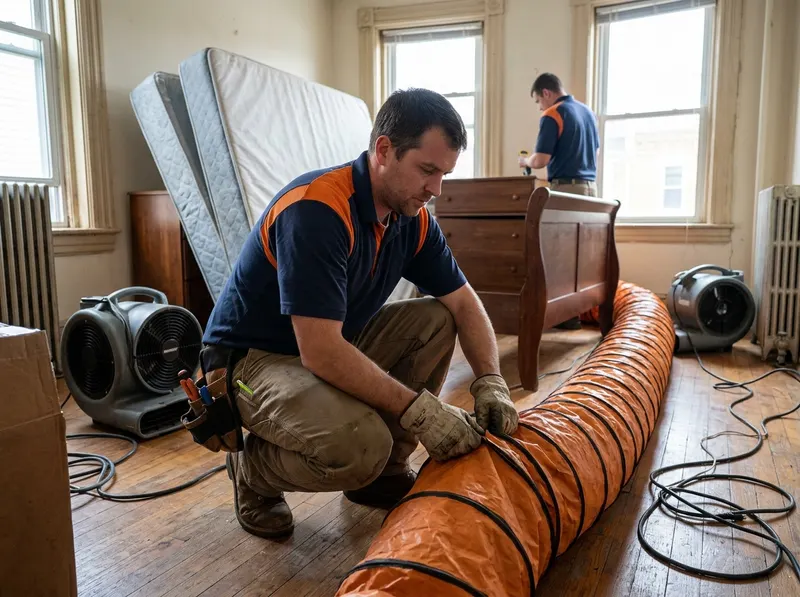
  • What is included: Full perimeter thermal diagnostics, placement of industrial high-output electric or indirect heaters, axial air movers, continuous temperature data logging, and targeted thermal monitoring of shared rowhouse party walls.
  • How fast: Treatments take 6 to 10 hours for a standard residence, allowing residents and pets to return the same evening once temperatures cool below 85°F.
  • What it costs: Ballpark costs range from $1,200 to $2,800 for a standard two-story brick rowhouse, with apartment units starting at $800 and single-room targeted treatments starting at our minimum charge of $150.
  • Preparation requirements: Residents remove wax items, aerosol cans, pressurized vessels, medications, sensitive electronics, vinyl blinds, oil paintings, and indoor houseplants prior to technician arrival.
  • How to schedule: Confirm home square footage and parking logistics by calling (267) 601-9681 for an initial technical intake and on-site physical inspection.

Philadelphia rowhouse architecture presents specific pest migration vulnerabilities because structural wall voids, shared party walls, and century-old joist pockets allow bed bugs (*Cimex lectularius*) to travel easily between adjoining properties in dense neighborhoods like Fishtown, South Philadelphia, and Queen Village. Chemical applications often trigger a repellent dispersion response, driving insects deeper into party walls shared with neighboring homes. Whole-structure thermal remediation overcomes this limitation by raising the structural core, wall voids, subflooring, and dense furniture past the lethal thermal death threshold of 118°F. At sustained ambient temperatures between 122°F and 135°F, insect cellular proteins coagulate, eliminating adults, nymphs, and embryonic eggs without leaving residual chemical film on personal belongings.

Preparing a multi-story home in Northern Liberties or University City requires structured steps to safeguard temperature-sensitive property while ensuring heat penetrates deep harborage areas. Step one involves clearing personal clutter from closets, removing heat-vulnerable items such as candles, musical instruments with organic glues, and prescription pharmaceuticals, and unzipping all mattress encasements. Step two entails technicians running heavy-duty power lines to dedicated electric heating units or running flexible ductwork from exterior trailer-mounted generators into the building envelope. Step three uses directional air movers to circulate 130°F air evenly through high-density areas, monitoring infrared sensors to confirm wall temperatures reach critical eradication thresholds.

Thermal remediation offers high single-intervention clearance rates, whereas traditional chemical applications typically require 2 to 4 separate visits spaced 14 days apart. The functional trade-off is front-end preparation labor and equipment footprint; property owners must coordinate street parking for equipment trucks along tight corridors near Manayunk or Rittenhouse Square and temporarily relocate indoor pets, reptiles, and heat-sensitive possessions for approximately 8 hours. When treating historic stone homes in Chestnut Hill or Mount Airy, interior plaster walls require slightly longer exposure times than standard drywall to guarantee internal core saturation. Every confirmed treatment plan includes a physical on-site evaluation to establish baseline room volumes and calculate precise British Thermal Unit (BTU) requirements.

Bed Bug Thermal Remediation cost in Philadelphia

Inspection & Thermal Assessment$150 - $250
Single Room / Studio Apartment Heat Treatment$650 - $1,050
Two-Story Philadelphia Rowhouse (1,000 - 1,400 sq ft)$1,200 - $2,200
Three-Story Rowhouse / Twin (1,500 - 2,200 sq ft)$1,800 - $2,800
Large Single-Family Home (2,300+ sq ft)$2,600 - $4,200

Every job gets a firm, written price after a free on-site visit.

Common questions

Will heat treatment push bed bugs into my neighbor's house in a Philadelphia rowhome?
Properly managed thermal remediation does not scatter insects because technicians establish lethal temperatures rapidly while simultaneously treating the perimeter and party-wall interfaces with industrial air movers. High-velocity fans eliminate cold pockets along shared brick and plaster walls, preventing bed bugs from retreating into adjoining properties in Port Richmond or South Philadelphia.
What items must be removed from a Philadelphia residence before heat remediation?
Residents must remove aerosol cans, fresh food, soft plastics, candles, cosmetics, medications, oil paintings, vinyl records, fire extinguishers, and living plants or pets before heating begins. Laptops, flat-screen televisions, and major appliances remain inside the structure, unplugged and positioned off exterior walls to allow thermal circulation.
How does Philadelphia rowhouse construction affect heat treatment duration?
Thick brick party walls and lath-and-plaster construction standard in older Philadelphia homes absorb heat more slowly than modern drywall partitions, requiring an extended heat soaking phase of 2 to 3 hours. Overall treatment times typically average between 7 and 9 hours to confirm core structural voids hold a minimum of 122°F for at least 60 continuous minutes.
Is a permit required to run thermal remediation equipment on Philadelphia streets?
Trailer-mounted heating rigs parked on public rights-of-way require appropriate street parking space or residential permits through the Philadelphia Parking Authority depending on block regulations. For dense blocks in Center City, Fishtown, or Queen Village, technicians utilize quiet electric internal heaters powered directly from the home's 240-volt range or dryer outlets to eliminate street obstruction.
What happens if a room in my Philadelphia property cannot reach lethal temperature?
If high thermal loss occurs due to uninsulated drafty windows or open crawlspaces, technicians apply localized structural sealing and deploy supplementary 18,000-BTU heating elements focused directly on that zone. Target areas that cannot safely sustain 125°F heat receive localized cryonite or targeted non-repellent desiccant dust applications to ensure full structural coverage.
Helpful resources

Trusted references & local links

USA.gov, government & consumer helpBetter Business BureauFTC Consumer AdviceU.S. Small Business AdministrationReady.govU.S. EPAENERGY STARU.S. Dept. of EnergyConsumer.govU.S. Census BureauGoogle Maps, Philadelphia, PA

Get started today

Tell us about your bed bug thermal remediation job in Philadelphia and we'll send a clear, written quote, usually the same day.
Get your free pest control service quote, Philadelphia

We only use your ZIP to check availability, no spam.