Kelvoro Pest SolutionsKelvoro Pest Solutions

Powderpost Beetle & Wood-Boring Insect Remediation Philadelphia

Powderpost beetle larvae burrow through seasoned sapwood, chewing gallery networks over 1 to 5 years before emerging as adults through 1- to 3-millimeter exit holes. In Philadelphia County, historic rowhouses…
Get My Free Estimate →(267) 601-9681
Powderpost Beetle & Wood-Boring Insect Remediation in Philadelphia, PA
Quick answer
  • What is included: Core wood moisture testing, exit-hole species identification, penetrating borate salts application, and structural timber sealing.
  • Turnaround time: On-site structural timber evaluations take 45 to 60 minutes; surface applications cure within 4 to 8 hours.
  • Cost range: Local remediation starts at a $150 baseline for localized joist treatments, ranging to $2,800 for whole-basement timber systems.
  • Pests addressed: Lyctid powderpost beetles, Anobiid deathwatch beetles, Bostrichid false powderpost beetles, and old house borers.
  • Contact method: Dispatch an inspector by calling (267) 601-9681 or submit high-resolution photos of wood exit holes and frass.

Powderpost beetle larvae burrow through seasoned sapwood, chewing gallery networks over 1 to 5 years before emerging as adults through 1- to 3-millimeter exit holes. In Philadelphia County, historic rowhouses throughout Queen Village, Northern Liberties, and Fishtown frequently harbor historic pine and oak floor joists vulnerable to Anobiid beetles, which thrive in sub-grade spaces where relative humidity exceeds 60%. Left unchecked, internal larval feeding reduces solid dimensional lumber into an ultra-fine, flour-like powder called frass, eroding structural stability from within without altering the exterior timber profile.

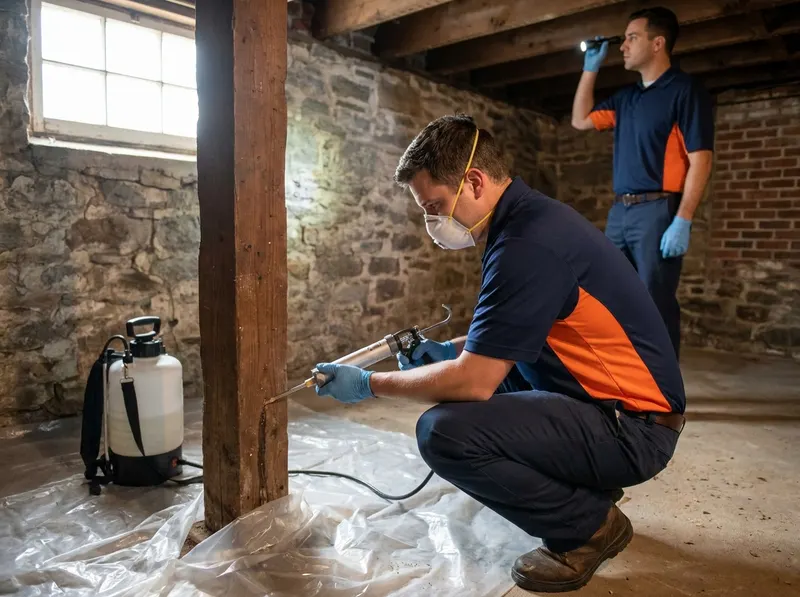
Remediation requires differentiating beetle damage from subterranean termite galleries. Termite workers hollow along annual growth rings and deposit mud tubes across masonry surfaces. Wood-boring beetles bore across wood rings and pack galleries with talc-like powder, creating distinct circular or oval exit shot-holes. Surface bug bombs and perimeter sprays fail because adult beetles do not walk across treated baseboards; larvae feed entirely inside the core wood. Treatment relies on direct liquid borate salt injection and deep surface misting over bare, unsealed structural beams, penetrating 0.25 to 0.75 inches into the grain to poison digesting larvae while leaving no volatile organic compound residues.

Decision guidance depends on wood finish and moisture levels. If joists in Chestnut Hill bank barns or South Philadelphia rowhouse basements show fresh, light-colored frass falling on concrete slabs, borate treatments stop active broods immediately. If floor timbers carry paint, polyurethane, or oil sealers, liquid borates cannot penetrate the timber matrix; remediation in these painted settings requires mechanical sanding of the face grain down to raw timber, injection via drilled injection ports, or complete timber sistering. Remediation halts active biological decay, but it does not replace lost load-bearing mass; joists with over 20% wood volume loss require structural reinforcement from a framing contractor.

Powderpost Beetle & Wood-Boring Insect Remediation cost in Philadelphia

Minimum Service / Single Joist Spot Application$150 - $350
Standard Rowhouse Basement Timber System (Raw Joists & Subfloor)$650 - $1,400
Multi-Story Structural Timber Treatment (Post-and-Beam / Exposed Framing)$1,200 - $2,800
Pre-Purchase Wood-Boring Insect Inspection & Documentation$150 - $275

Every job gets a firm, written price after a free on-site visit.

Common questions

How does wood moisture affect powderpost beetle treatments in Philadelphia?
Active powderpost beetle larvae require timber moisture levels above 12% to survive, making humid cellars in Manayunk and Port Richmond primary targets. Liquid disodium octaborate tetrahydrate treatments use wood moisture to diffuse deep into the timber pores, yielding faster penetration in damp historic lumber.
Can powderpost beetles spread between attached Philadelphia rowhouses?
Adult beetles are weak fliers that emerge in spring and generally re-infest the same joists or adjacent exposed party-wall structural timbers. While they do not travel through masonry mortar joints like rodents, beetles spread if unsealed joist pockets allow adults to reach untreated wood framing in shared wall systems.
Are borate treatments for wood-boring insects safe for indoor pets in Philadelphia homes?
Borate salts bind directly to the internal cellulose fibers of structural lumber and exhibit low mammalian toxicity once dry. Homeowners and indoor pets can safely re-enter the treated area within 2 to 4 hours following initial surface application.
What is the difference between active and old wood-boring beetle damage in Philadelphia?
Active infestations feature sharp-edged exit holes surrounded by fresh, cream-colored wood powder (frass) that sifts out when joists vibrate. Inactive damage displays gray, weathered holes and dark, crusty frass remnants dating back decades to original timber milling.
Does homeowner insurance in Philadelphia County cover powderpost beetle remediation?
Standard Philadelphia property insurance policies classify wood-boring insect infestations as preventable structural maintenance and consistently exclude beetle remediation and joist repairs from coverage.
Helpful resources

Trusted references & local links

USA.gov, government & consumer helpBetter Business BureauFTC Consumer AdviceU.S. Small Business AdministrationReady.govU.S. EPAENERGY STARU.S. Dept. of EnergyConsumer.govU.S. Census BureauGoogle Maps, Philadelphia, PA

Get started today

Tell us about your powderpost beetle & wood-boring insect remediation job in Philadelphia and we'll send a clear, written quote, usually the same day.

Get your free pest control service quote, Philadelphia

We only use your ZIP to check availability, no spam.