Subterranean termite colonies in Philadelphia operate primarily underground, requiring direct soil moisture to survive while tunneling upward through mortar joints, stone foundation gaps, and expansion cracks. In dense…
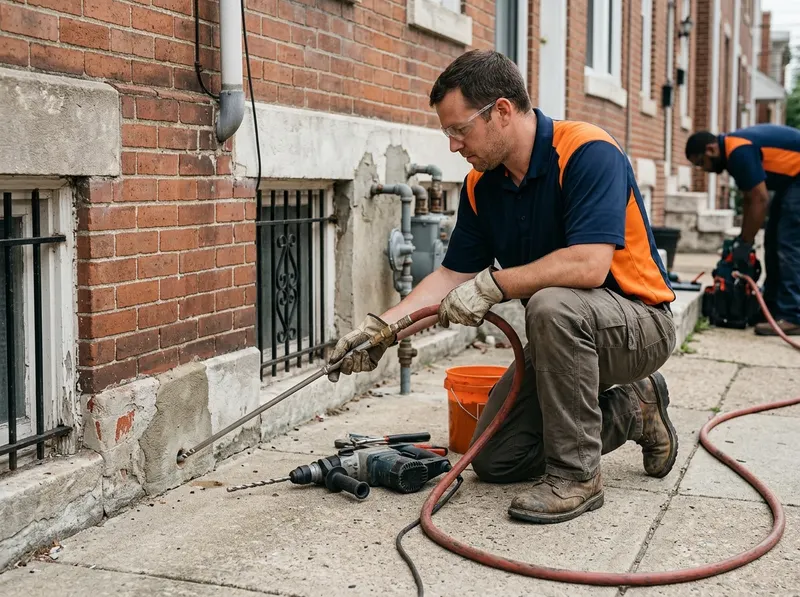
Subterranean termite colonies in Philadelphia operate primarily underground, requiring direct soil moisture to survive while tunneling upward through mortar joints, stone foundation gaps, and expansion cracks. In dense neighborhoods like South Philadelphia, Fishtown, and Northern Liberties, interconnected brick rowhomes present continuous subterranean pathways. Termites exploit subterranean soil along ancient sewer laterals and party walls, bypassing traditional open-yard barrier treatments. Standard exterior perimeter spraying fails in high-density urban corridors because termites enter directly beneath solid concrete basements or shared rubble foundations. Liquid termiticide application establishes an uninterrupted horizontal and vertical non-repellent chemical envelope beneath slab floors, preventing colony access without displacing adjacent dwellings.
Treatment selection depends entirely on foundation typology. A historic rubblestone or fieldstone foundation common in Mount Airy, Chestnut Hill, or Queen Village requires specialized interior slab trenching and low-pressure injection into voided foundation walls to saturate hidden galleries. Modern or finished basements along University City or Rittenhouse Square require precision drilling through concrete slabs at 12-inch intervals along load-bearing masonry to inject non-repellent termiticide directly into the underlying aggregate. For steep-slope rowhomes in Manayunk or properties bordering the damp timber corridors of Wissahickon Valley Park and Fairmount Park, liquid barrier establishment must be paired with low-profile subterranean bait stations placed along outdoor soil strips to intercept foraging workers before they breach masonry footers.
Structural protection balances invasive intervention against structural preservation. A targeted liquid barrier provides immediate colony mortality within 60 to 90 days as worker termites transfer active non-repellent compounds back to the central nest. The operational trade-off centers on property access: interior drilling requires moving items 2 to 3 feet back from perimeter basement walls and temporarily lifting floor coverings, whereas exterior bait installations require zero interior disruption but necessitate 12 to 18 months of ongoing station monitoring to achieve full colony suppression.
Every job gets a firm, written price after a free on-site visit.
Tell us about your subterranean termite treatment job in Philadelphia and we'll send a clear, written quote, usually the same day.
 Kelvoro Pest Solutions